• Increasing Processes, Sessions and Transactions in Oracle XE

    by  • June 22, 2009 • 28 Comments

    Disclaimer: following my technical advice has been known to scratch cars, void lottery tickets and confuse guide dogs – proceed at your own risk..

    Oracle Express Edition (XE)

    Out of the box, Oracle Datatbase 10g Express Edition RDBMS is fast and powerful. The stated limitations of 2GB of maximum RAM usage and 2GB of total datafile management are plentiful for it to easily run as the back-end for a small to medium-sized office application. However, we soon hit a connection limit as characterised by the following Oracle Errors:

    ORA-12516: TNS:listener could not find available handler with matching protocol stack
    ORA-00020: maximum number of processes (%s) exceeded
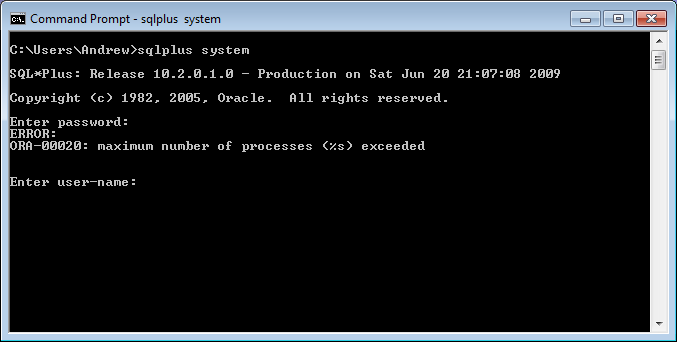
    ORA-00020: maximum number of processes (%s) exceeded

    We can get this second message because Oracle creates Operating System processes to handle Connections (or Sessions) – which means Processes, Sessions (and as we’ll soon see..) Transactions are all related.

    The default values in Oracle XE for these parameters are:

    • Processes =40
    • Sessions = 49
    • Transactions = 53

    I was able to generate the above error message (ORA-00020) from about ~30 connections on a vanilla Oracle XE installation (on Windows 7).

    So, let’s increase these limits to allow more connections to our Oracle Server..

    1. Log in as SYSDBA

    From the menu ‘Oracle Database 10g Express Edition’, find and select ‘Run SQL Command Line’, then type:


    and enter your SYS, or SYSTEM password at the prompt
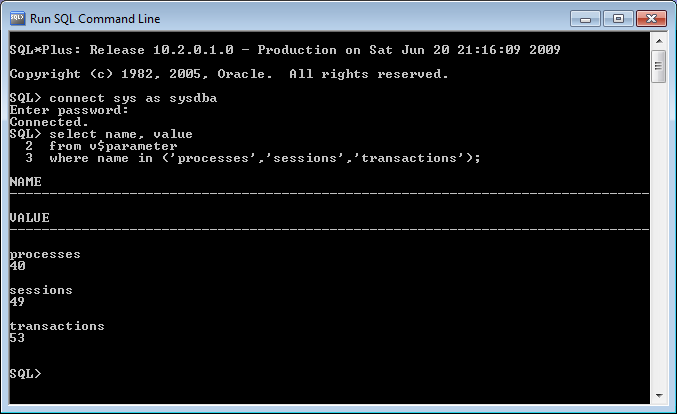
    oraclexe-default-processes-sessions-transactions

    2. ALTER SYSTEM commands

    Update: The Oracle XE 10g documentation links were broken, so they now point to the Oracle 11g R2 Standard Edition documentation instead – note that the default values are greater in 11g R2 Standard than the Express Edition (XE).

    The Oracle Documentation states that TRANSACTIONS is derived from SESSIONS, which in turn is derived from PROCESSES, thus:

    PROCESSES = 40 to Operating System Dependant

    SESSIONS = (1.1 * PROCESSES) + 5

    TRANSACTIONS = 1.1 * SESSIONS

    So, what to start with for PROCESSES?  Trebling it is as good a start as any, then I’d add a few more for good measure..  Here are the values I recommend:

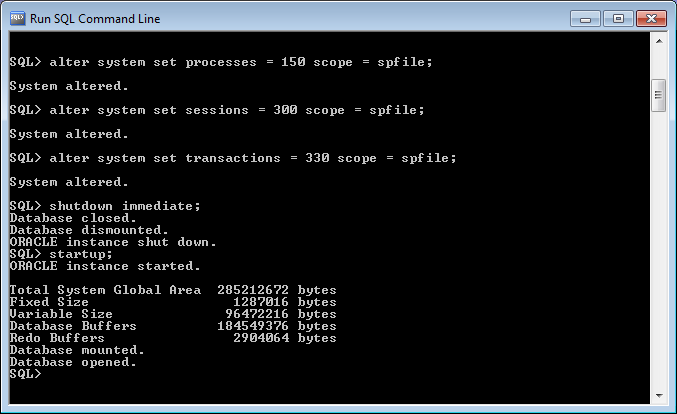
    • PROCESSES = 150
    • SESSIONS = 300
    • TRANSACTIONS = 330

    type the following commands:


    then to make the settings take effect, we need to bounce the database..


    oraclexe-alter-system-commands

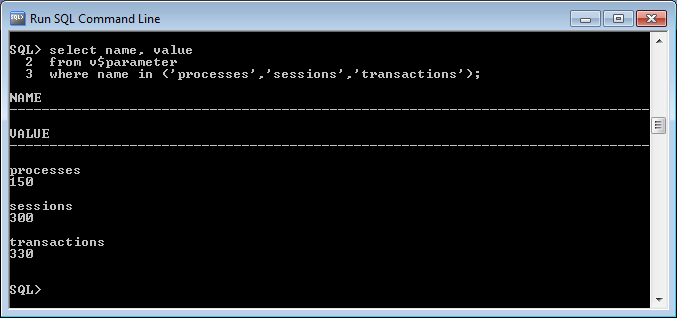
    3. Verify the new parameters

    with this simple select statement..


    oraclexe-updated-processes-sessions-transactions

    And we’re done – a free, light and powerful Oracle RDBMS that’s able to serve more connections

    About Andrew Freemantle

    28 Responses to Increasing Processes, Sessions and Transactions in Oracle XE

    1. Nicolas
      January 26, 2010 at 4:19 pm

      Thanks, this is straightforward and working !
      Now up and running with parallel unit tests, still failing, but for good reasons !

    2. Hassene
      February 11, 2010 at 8:53 am

      thanks a lot

      you really help me

      but are this values the max we can choose for oracle express ?

      processes = 150

      sessions = 300

      transactions = 330

      !

    3. February 11, 2010 at 8:33 pm

      Hi Hassene, I’m glad it helped you :)

      While there will be an answer to your question of what are the maximum values for Oracle Express, there are a few key factors I’d need to know first:

      1. What Operating System are you running it on?
      2. Is the Operating System 32bit or 64bit (although Oracle XE is 32bit only, this still affects how many processes the OS can handle in total)
      3. How much RAM is available to the Operating System

    4. February 15, 2010 at 4:25 am

      Thanks for this. Whenever I need to install XE, I go to this site afterwards to change the settings (fatlemon is so easy to remember :-) )

    5. Kxxx78
      February 18, 2010 at 3:15 pm

      Thank you very much, you save me today :) !

    6. Sram
      March 19, 2010 at 2:03 pm

      Hi Andrew,

      I altered the sessions to 150, but everytime I restart the xe database it defaults to 49. Do I have to configure the pfile manually if I want to store it permanently?

      Thanks

    7. March 19, 2010 at 10:28 pm

      @Sram – you shouldn’t have to edit the pfile manually to get these values to save permanently – that’s why we’re using the ‘scope’ argument.

      Are you logging in as sysdba?
      Are you including the ‘scope = spfile’ on the alter system commands?

    8. Eddie Hapson
      May 17, 2010 at 3:09 am

      Wow! this info saves me. Thank you so much Sir Andrew for this guide…it really helps me a lot…

    9. October 29, 2010 at 3:13 pm

      Thanks a lot !

      The step are simple to understand and helped me a lot.

      Good Work !!

    10. Apoorva
      December 2, 2010 at 3:39 am

      Thank You very much, Andrew..! U r a savior.. : )

    11. Ocky
      April 19, 2011 at 7:31 am

      Wah, keren banget mas. Infonya bagus banget! Makasih banyak!

    12. Alexandr
      May 3, 2011 at 9:49 am

      Thanks a lot!
      This article is really helpful for me :)

    13. Dinesh Ranganathan`
      July 21, 2011 at 11:05 am

      Thanks a lot!
      It works!!!

    14. sutanu.nitdgp@gmail.com
      November 17, 2011 at 4:55 am

      Hi Andrew
      Thanks for your valuable tips…. I am facing another problem about the max size of the express database limit (4 GB). Would you please help me in this regard ? Is it possible to increase the database size of oracle express database ?

    15. November 17, 2011 at 2:31 pm

      Hi Sutanu,
      The 4GB data limit is a fixed limit for Oracle Express, and cannot be changed.

      Your upgrade path is to Oracle Standard Edition One, which has a minimum 5 user license and costs GBP £737.70 (about USD $1,170). Definitely call Oracle first, because they have new company discounts.

    16. yalkoki@gmail.com
      December 12, 2011 at 10:42 am

      Thank you very much it works fine but
      my database has not started yet?
      what is the reason Andew.

    17. December 12, 2011 at 11:38 am

      Thanks @Yalkoki

      Do you have any error messages, or does it look like it’s just sitting there thinking about it?

      It should come back within a couple of minutes. If it doesn’t, try restarting the Oracle services

    18. yalkoki@gmail.com
      December 14, 2011 at 5:39 am

      Thank you Andrew
      After restarting the service it works.

    19. sssvim@gmail.com
      December 28, 2011 at 7:04 am

      Thank you Andrew
      really awesome description keep it …!!!!!!!!!!!

    20. Sivaram
      December 30, 2011 at 12:43 am

      Thanks a Lot !! Andrew

      It worked for me as well.

    21. Sunil
      February 12, 2012 at 12:24 am

      Awesome, explanation. It worked for me. Thanks.

    22. Sunil
      February 12, 2012 at 12:38 am

      PROCESSES = 40 to Operating System Dependant
      SESSIONS = (1.1 * PROCESSES) + 5
      TRANSACTIONS = 1.1 * SESSIONS

      PROCESSES = 150
      SESSIONS = 300
      TRANSACTIONS = 330

      PROCESSES = 150
      SESSIONS = (1.1 * 150) +5 = 170
      TRANSACTIONS = (1.1 * 170) = 187

      I got a bit confused with these values, please help. I have set the values as 150, 300 and 330 but need a bit more clarification for the calculation.

    23. February 12, 2012 at 12:45 pm

      Hi Sunil,

      You’re correct, starting with a PROCESSES value of 150, and following the Oracle documentation, you’d get

      PROCESSES = 150
      SESSIONS = (1.1 * 150) + 5 = 170
      TRANSACTIONS = (1.1 * 170) = 187

      But I wanted Oracle XE to handle more than 170 SESSIONS, so I could have started with the number of SESSIONS I wanted (I think of SESSIONS as concurrent connections), and worked out the other two values like so:

      SESSIONS = x
      PROCESSES = (SESSIONS – 5) / 1.1
      TRANSACTIONS = (1.1 * SESSIONS)

      which would have given me

      SESSIONS = 300
      PROCESSES = ((300 – 5) / 1.1) = 268
      TRANSACTIONS = (1.1 * 300) = 330

      Where did my 300 SESSIONS come from? At the time I wrote this article, I was supporting an internal Oracle XE installation that had ~80 users, so I trebled it to cover those power admin users that run multiple copies of the application (which gives me 240), then rounded it up to 300 because I like round numbers – though 256 is arguably the closest round number.. ;)

    24. Leonard
      February 24, 2012 at 1:52 pm

      Hi,
      I am new to Oracle. Am running Oracle Database 10g Enterprise Edition Release 10.2.0.1.0. Am in Financial Institution.
      I have met settings for processes, sessions and transactions being 150,170 and 187 respectively.

      After deploying one application that passes through data to Oracle, the application log has been registering ERROR [HY000] [Oracle][ODBC][Ora]ORA-00604: error occurred at recursive SQL level 1
      ORA-00018: maximum number of sessions exceeded.

      I want to increase the above parameters values. Can you help me with Guidance?

    25. February 24, 2012 at 3:35 pm

      Hi Leonard,

      Sure, what guidance do you need?
      If the values are 150, 170 and 178 and you’re still seeing ORA-00604, increase your SESSIONS, PROCESSES and TRANSACTIONS again, to a higher number.

      What number you ask? well how about 2x or 3x the number of users as a guide for SESSIONS, then working out PROCESSES and TRANSACTIONS as described in my last comment above?

      Hope that helps :)

    26. Stefan
      May 1, 2012 at 9:08 pm

      Dear Andrew,
      Please could you help me?
      I’ve change parameter processes to value 258 and sessions to 516 but Oracle change sessions automatically to 520. Could you tell me why? And is it problem?

      Thank you for your reply

    27. September 6, 2012 at 4:11 pm

      Hi Stefan, thanks for your comment. The short answer is I don’t know why Oracle sets the SESSIONS as 520 when you specify 516. If your Oracle Database is starting up, then no, it’s not a problem!

    28. SAM
      January 10, 2013 at 8:25 am

      It is great to see this kind of crystal clear article, Thank you so much. this helped a lot.

    Leave a Reply

    Your email address will not be published.

    Your name *

    Your website

    *